
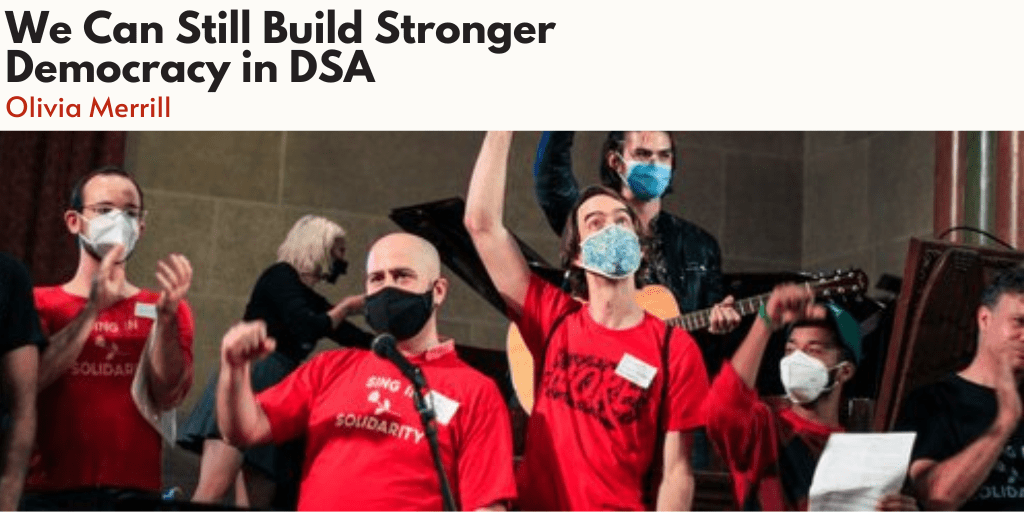
DSA Metro Cincinnati & Northern Kentucky’s Olivia M. takes stock of the 2023 DSA convention, and outlines the questions that our internal democracy faces as we mature and scale up our organizing.
The 2023 National Convention of the Democratic Socialists of America concluded a month ago, the new National Political Committee has begun their work, and two internal elections are quickly approaching. At this moment, it’s worth asking what new patterns of behavior and organizational practices are worth turning a critical eye to, and what the stakes of these behaviors are. This article reviews two concerns that have come up in the month and a half since the convention concluded. These concerns are loosely connected by one major theme: democratic practice in an organization, and the tensions between our ideal of democracy and the actual culture we carry out in DSA. While views on how we can best build democracy in DSA are extremely varied and nuanced, this piece aims to identify common questions that these differing viewpoints should seek to answer as we move forward.
Democracy On the Ballot
At the Convention, voting was primarily carried out through OpenSlides, in which after debate had closed, members would submit their votes and have them internally tallied by the system. The overall vote result would be presented as a graph to the convention floor, usually to celebration by those voters who had won the majority. The most intriguing aspect of the tool, however, was the ability to search for a given delegate by name to see how they had voted on each item.
The consequence of this function was perhaps most visibly seen in the follow up to the YDSA Consensus Resolution. After this resolution passed with a supermajority of delegates, an elected leader of YDSA took to Twitter to name every NPC candidate who had voted No on the resolution, urging delegates to not rank any of these candidates. What’s interesting about this, however, is not simply that access to how people had voted was used as a political weapon (this has always been common in DSA), but that some delegates anticipated both that this would happen and that the resolution would pass, and so voted for it to avoid public critique.
To be clear: this is not an attempt to relitigate any of the resolutions or amendments that were passed at Convention, which should be treated as the democratically adopted (or rejected) decisions of our highest body. Rather, it’s an attempt to draw out a question for our membership to consider: what should (or shouldn’t) impact the voting behavior of our convention delegates?
The ideal of a deliberative democracy is that the body, by considering the arguments for and against a given motion, will ultimately come to a decision that makes the most sense to the majority of people that are in attendance. In the view of the author, this means it is desirable to allow voters to make decisions first and foremost according to their own logical conclusions, given the arguments and information presented. In practice, democracy often tends to have competing factors-cliques and loyalty can overwhelm a person’s rational considerations, as can frustration, boredom, or any other number of emotional factors.
That said, any functional democracy has practices that are meant to ensure members are able to participate in the process and not be dominated by the loudest voices. This is why, while DSA accepts that personality and emotion can sway votes, the organization also keeps and enforces a Code of Conduct in our meetings as an organization. Drawing those lines is our job as an engaged membership, to ensure our democracy functions. And open, searchable ballots present a tension for democratic practice in the organization.
This is a question with practical impact in our organization now. The author spoke to multiple delegates who said they voted a particular way because they were worried how others in their delegation or in the organization would respond to their votes. And many of our organization’s caucuses (which do not exist as formal bodies in DSA—more on this later) have strong lines they expect their members to carry out. The potential these caucus members might vote out of line based on the strength of the floor debate all but vanishes, when the potential consequences of voting out of line with your caucus present themselves.
To address these dynamics, DSA members should consider whether a secret ballot at Convention would be healthier for the organization. Such a change would remove virtually all the pressures described above, which require other members having direct access to the votes of every delegate. If it is the desire of DSA to have a Convention that attempts to make decisions based on what each delegate thinks is the best course of action, it is worthwhile to attempt to minimize these other factors in our democratic decision-making process.
It has been suggested that such an approach removes the ability for chapters to hold delegates accountable for their votes, or for chapters to effectively bind delegates to vote in accordance with the will of the chapter on a given motion. To be frank: this is completely contradictory with Single Transferable Vote being the dominant election system. It’s illogical to use a proportional voting system to choose delegates, only to then use majoritarian voting to instruct those proportionally elected delegates in how to vote. Similarly, STV as a system does not elect representatives who are accountable to a majority, but those who represent a given proportion of the chapter electorate. If STV is the standard election system, it should be expected that there will be delegates who represent minoritarian tendencies in a chapter and vote accordingly. Only in chapters that adopted majoritarian voting systems would it be logical to even consider binding delegates, and as far as the author is aware, none of those chapters attempted such a thing.
It’s also misguided to suggest that convention delegates should have the personal character to resist such influences at convention. While DSA has made impressive strides in its ability to collectively make and respect decisions (as shown by this Convention!), there still is not a strong collective concern for the development of members to resist such impacts in their decision making. If the organization wants to have both public ballots and a membership that is largely capable of resisting the natural peer pressure such ballots entail, it has to invest in the development of a membership capable of both.
The primary beneficiaries of delegate voting patterns at convention being publicly available are, to be frank, political caucuses in the organization. Public votes allow for better factional coordination, to more easily know who is a future ally or future opposition in a given chapter. They give insights on who to schedule a one on one conversation with, or who to leave out of a round of potential appointments. The question for membership is whether the ability of caucuses to organize as efficiently as possible for organizational power is an important enough concern to undermine the deliberative function of organizational democracy. This question naturally leads to another: what is the proper role of a caucus in the democracy of DSA?
Caucus Reform
The NPC took the first steps toward launching the Trans Rights and Bodily Autonomy Campaign Commission (TRBACC) at its first full meeting, setting up the structure for a Steering Committee and a timeline to start the commission’s work. The NPC resolution to start this, however, had an unusual clause: a clarification that of the eight non-NPC candidates to serve on the body, there can be “no caucus holding more than three seats.” Notably, a similar expectation was at one time pushed in the GDC, though this fell by the wayside with time. In many ways, this is a final conclusion of a tendency that has been seen repeatedly over the course of DSA’s recent history, to gesture to the importance of ‘multi-tendency’ bodies in national apparatuses. While well-intentioned, these moves deserve a more critical examination.
If the organization wants to have both public ballots and a membership that is largely capable of resisting the natural peer pressure such ballots entail, it has to invest in the development of a membership capable of both.
This conversation should start by clarifying a simple principle: caucuses are a necessary and inevitable aspect of a democratic organization, and the impulse to distrust them or view them as a distortion of democracy itself misunderstands the basic principle of organization. After all, organizations like DSA serve (more or less) a similar function that caucuses serve within them: to attempt to steer the larger social group they exist within in a direction they believe will ultimately better that social group.
It is better for everyone within DSA when caucuses are clear and open about their existence and purpose, and when the vision of each formation for the larger organization are made clear to regular membership. It is also vital for the members of each of these caucus formations to identify with DSA more than they identify with their caucus. Members should engage with caucuses out of a belief that DSA is important and worth building, rather than engaging with their caucus as political home, and DSA as simply one place among many it engages in.
There is also an open question regarding the finances and resources that go to caucuses in campaigning for power on the local and (even more importantly) national level. No exact numbers are available, but it is the author’s understanding that some national caucuses take dues or fundraise amongst their membership to win at Convention. DSA has no internal campaign finance rules, nothing to moderate the financial activity of caucuses in DSA.
In fact, political caucuses have no formal existence in DSA at all. There are no guidelines on permissible and impermissible behavior, no structure by which to moderate the limits of acceptable caucus politics, and nothing like what the Workers Party (PT) of Brazil has as far as defining the differences between caucuses and ‘parties within the party.’ Caucuses have no formal, organizational rights to representation, to be listened to, or to be noted or acknowledged by the national organization—that is a right that is reserved for membership. And while plenty of active cadre in DSA are members of caucuses, the simple truth is the vast majority are not, and likely cannot be. To consider candidates and representation in DSA’s national politics on the basis of caucus affiliation as a primary principle in candidate selection de facto disenfranchises thousands of members. Maintaining a balance between caucuses should not become a more important consideration than intentional recruitment of members who have not already become part of the web of national politics. This approach to organizational politics only deepens the divide between the national organization and the thousands of local chapter members who regularly have zero interaction with the national organization and its political caucuses.
This also poses another question: why are campaign commissions and working groups, bodies that ostensibly have a clear mandate and course of action approved by the national convention or by the National Political Committee, treated as if they function as independent political entities and so must be diverse in political viewpoints? The Trans Rights and Bodily Autonomy Campaign Commission has a clear course of action mapped out for it by the NPC and broadly supported convention resolutions, and will have significant NPC oversight in how it carries out its efforts. What is the purpose of caucus diversity in a body that should first and foremost be carrying out the will of the national convention and the organization’s elected leadership? As noted elsewhere, setting such a body up to engage in debates on contradictory or incoherent tactics, particularly when a course of action has already been set for the body, is nonsensical.
I suggest two steps: Firstly, the organization should abandon multi-caucus representation as a necessary measure of how to choose the composition of national working groups and commissions entirely, and secondly, the organization should formalize the basic existence of caucuses in DSA as a whole-adopt rules akin to those held by serious parties like the PT of Brazil and set limits on what caucuses are and aren’t allowed to do as part of their engagement in the org. These rules should regulate campaign finance in DSA in terms of how caucuses spend in internal regulations (particularly given there are now paid leadership seats), set rules on the hiring of staffers and paying of dues to caucuses, determine whether caucuses should be required to have bylaws within guidelines proposed by the organization, and further formalize a democratic process that is necessary and essential to the org. This would benefit caucuses as well, who could more formally appeal to membership across the org and play a key role in drawing connections between the national organization and local chapters.
Such rules can also ensure caucuses have to conduct their own behavior in accordance with the organizational Code of Conduct and the interest of the larger organization. Many members, for example, have just concerns about a caucus misrepresenting the nature of an internal decision or disagreement online. Presently, such situations have no real solution, as caucuses exist outside the formal structure of the organization. Establishing caucus rules would ensure everyone needs to abide by basic principles of good faith discussion in how they engage in the organization.
Democracy must be able to create a collective mass organization that is capable of fighting for power and taking control of it from the capitalist class
The Purpose of Democracy
Democracy is not an easy thing, least of all when an organization has a thousand definitions of it all competing for consideration. The clearest way to cut through these definitions is to ask ourselves what the instrumental purpose of our democracy is. The author would propose two key purposes to democracy in an organization like DSA. Firstly, democracy must allow membership to make those decisions that they believe are most clearly in the interest of the organization. Insofar as it is possible, DSA must eliminate outside pressures that would cause members to vote in a manner contrary to what they consider the organization’s best interest. And secondly, democracy must be able to create a collective mass organization that is capable of fighting for power and taking control of it from the capitalist class. This cannot happen, however, if the desire for fair factional representation results in practice in a fundamentally oligarchic relationship of power in the organization. Caucus engagement must be handled in such a way that the vast majority of membership is able to establish a clear relationship to national politics, rather than existing on the sidelines in locals.
DSA is currently many organizations, spread across the country. The process of a successful democracy, one that seeks to create a collective membership capable of participating in the organization’s national politics, will make it one.
 Mass
Mass 